



Top Court Lifts Curtain on Decision-Making at Legal Event
Members of the Colorado Supreme Court sat down with lawyers on Wednesday to answer questions about behind-the-scenes topics, including what happens immediately after an appeal is argued, why they might intervene in an ongoing case, and the consequence of a majority flipping from one side to the other.
“This is what happens when the court flips. The chief turns to you and says, ‘Well, Justice So-and-so, you seem to have lost the majority. So, the choices are: You can turn your majority opinion into a dissenting opinion and let someone else write the majority. Or you can change your majority opinion to get more people on board.’ Those are the choices,” said Justice Carlos A. Samour Jr.
He added that, in his eight years on the court, changes of mind that altered the outcome have only occurred two or three times.
Five of the seven justices appeared at the Denver law office of Wheeler Trigg O’Donnell LLP at an event sponsored by the nonprofit Colorado Judicial Institute. They held a series of discussions with attorneys and fielded a wide range of questions about internal court operations. Justice Brian D. Boatright and Maria E. Berkenkotter were unable to attend.
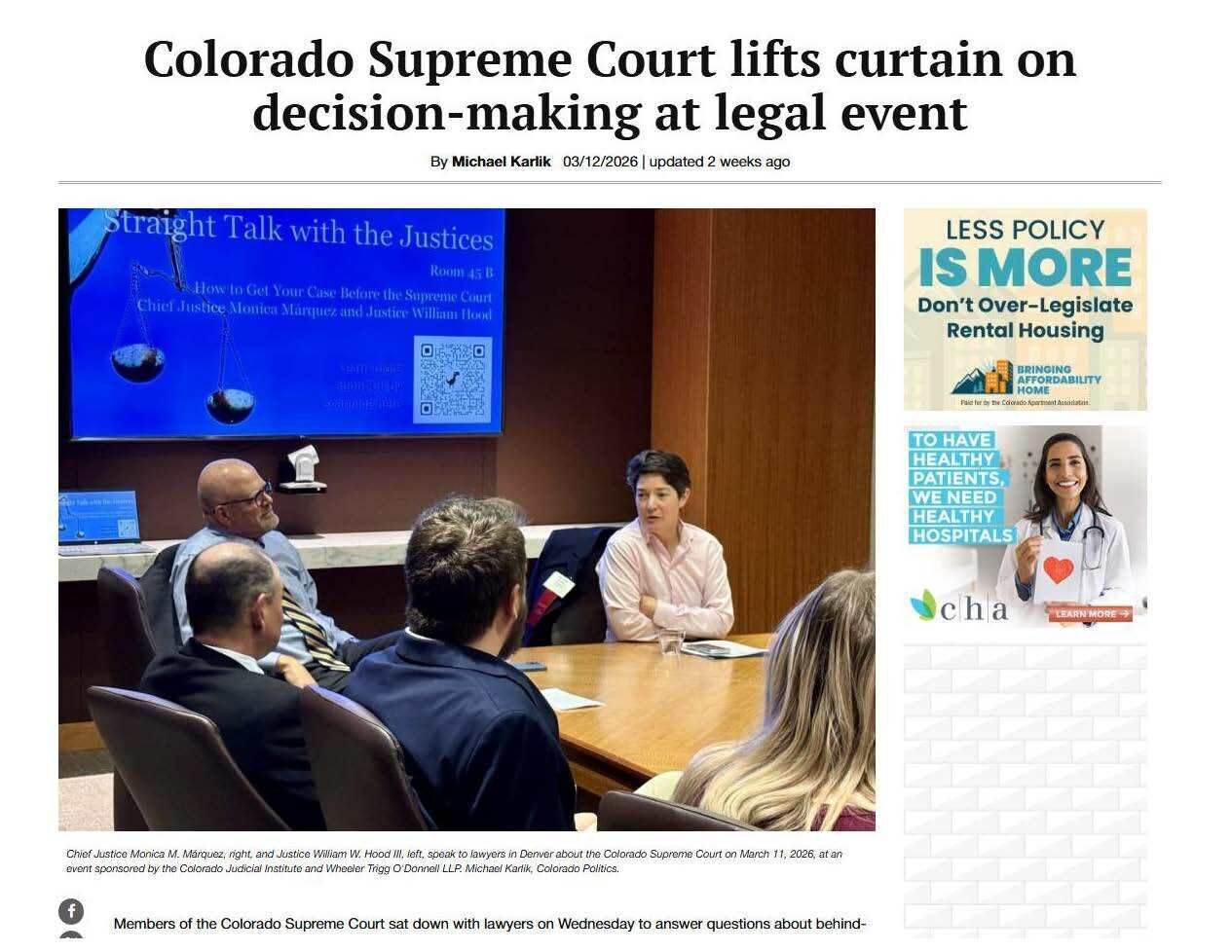
Chief Justice Monica M. Márquez and Justice William W. Hood III spoke about the process for intervening in an ongoing trial court case, outside of the normal appellate process. Hood said that attorneys typically focus on the trial judge’s alleged error, but the justices want to know why the state’s highest court needs to step in immediately.
"Where’s the fire? Why do we need to take this now?” he said. “The argument that the trial court was just dead-bang wrong on this and I shouldn’t have to slog through this whole case, it’s not fair to my client from an economic perspective—that’s not gonna move the needle a whole lot because a lot of folks could say that.”
Márquez said that the court takes family law cases seriously, including urgent issues involving children. If a trial judge’s decision is debatable but within their authority, the Supreme Court will likely not step in. But if there is a legal error, “that’s more likely the kind of case where we’d drop in and correct the legal error,” she said. “Or if a remedy in a child’s situation would be so far down the line that for all intents and purposes it would be meaningless.”
“Frankly, as someone who presided over domestic dockets in Denver for several years, I’d like to see more of those (cases),” said Hood, a former trial judge.
In cases the court hears through the normal appellate process, known as granting “cert,” Márquez said she considers the consequences if the court does not step in and allows a precedent-setting decision of the Court of Appeals to stand.
“I don’t think you should necessarily worry that just because we’ve granted cert, we’re inclined to reverse. We’ve granted cert because we’ve identified a legal issue that warrants our consideration and we’d like to provide guidance,” she said. “It’s not necessarily like, ‘Uh-oh.’”
Rarely, the Supreme Court will dismiss an appeal that it previously agreed to hear. In those instances, all members have to be on board with that outcome. “If any single justice is like, ‘We’re staying in,’ then we’re all in,” said Márquez.
Justice Samour noted that his law clerks may use artificial intelligence as a limited writing aid, but not expansively. He mentioned a program the Chief Justice learned about at a conference that can perform citation checks and fixes in about a minute. “We thought that’s an interesting tool that we might want to look into,” he said.
During his early years on the court, Samour said the justices would generally meet after oral arguments and vote to reverse or uphold the underlying decision without discussing the case. Over time, the justices began to discuss the cases first. Now, the court almost always has a discussion before voting, unless the outcome is straightforward.
“We do not talk about cases as a group before oral arguments,” he said. Although justices might have preliminary conversations, “don’t make up your mind until we get together to vote.”
After oral arguments and discussions, the Chief Justice may wait a few days or a week before assigning the majority opinion. Criteria for assignment include the types of questions a justice asked, their reasoning, and their existing workload. “And you’re not allowed to say, ‘Hey, I don’t want this opinion,’” Samour joked.
Justice Susan Blanco and Justice Richard L. Gabriel spoke about their preferred tone for decisions and arguments. Blanco, who was sworn in recently as the newest member, expressed a preference for a neutral tone in writing.
“I think judicial opinions should be very hesitant to use humor,” added Gabriel. “I’ve seen lawyers try to crack a joke. Every single time, it lands like a lead balloon... When the judge makes a joke, then you can laugh.”
Gabriel also mentioned that he sometimes asks "softball" questions to help a lawyer who is being overwhelmed by a "barrage of questions" from other justices, helping them refocus on their strongest arguments.
