



Four Colorado judges receive awards
By Michael Karlik
Published October 29, 2026 6:04am
Updated October 31, 2026 10:30am
Four members of Colorado’s judiciary received awards last week recognizing their personal initiatives inside and outside the courtroom.
“Fear is what keeps people from trying. Fear of the unknown. Not knowing how you’ll feel after you have this discussion,” said Boulder County District Court Judge Dea M. Lindsey, who received the judicial leadership award for her work to promote equity. “When you decide to join with a group that cares about this issue, as we should … then you find others just like you and you can open up to them and create that trust.”
The event was sponsored by the Colorado Judicial Institute, a nearly 50-year-old nonprofit that focuses on public education and advocacy about Colorado’s judicial selection and retention system, and the work of the courts more broadly. Its annual dinner features awards presented to one district court judge, one county court judge, and one magistrate.
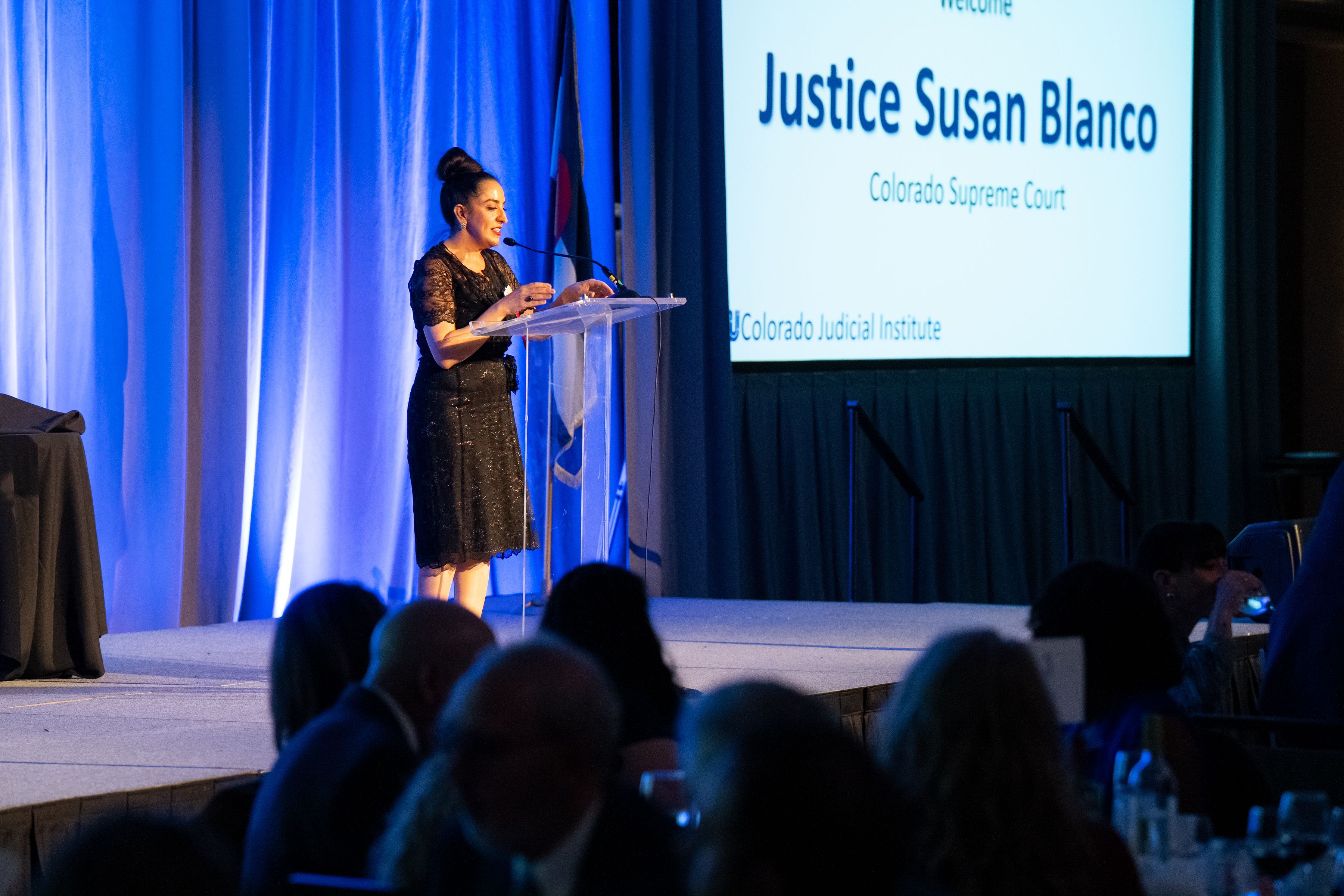
At the Oct. 22 dinner in downtown Denver, the 2025 district judge honoree, now-Justice Susan Blanco, delivered lighthearted opening remarks about her role as the “baby justice” of the Colorado Supreme Court.
“I asked AI, ‘What is this baby of this group supposed to aspire to be?’ And it responded very seriously: ‘Colorado may now possess the most overqualified infant in judicial history,’” said Blanco.
She also alluded to the Supreme Court’s recent move to sidestep the law requiring livestreaming by default in criminal cases. In issuing a directive allowing trial judges to discontinue their streams, the chief justice wrote that some users engaged in unauthorized editing, posting, and monetization of streams.
“We’re trying to create greater access to justice by allowing our courts to be livestreamed and the public to be able to see the great work that’s being done,” said Blanco. “But technology brought new challenges that were unexpected: the monetization of our courtrooms on YouTube and a parade of we-don’t-even-know-what-exactly someone might be bombing into our courtrooms, to display on cameras in our courtrooms — that are not really appropriate to talk about at dinner.”
She ended by thanking attendees for their public service.
“Societies flourish when the rule of law is strong and they certainly fracture when it’s not,” Blanco said. “We should remember how quickly rights, securities, and hope can be lost.”
Lindsey received the leadership award for creating the Judicial Equity Project, which aims to enhance the judiciary’s awareness of and application of equity principles.
“Judge Lindsey not only wants to diversify our bench, but she actively creates programs that welcome diverse judges to the bench and makes them want to stay on the bench,” said Arapahoe County District Court Judge LaQunya Baker-McKay in introducing Lindsey. “She understands what it’s like when judges of color are second-guessed by their peers, by their attorneys. She understands what it feels like when they are doxed and tagged online.”
“Without equity, there is no justice,” said Lindsey, who thanked the Colorado Judicial Institute for supporting her work. “Organizations don’t support this effort, particularly in the environment we’re in now, because it’s difficult. Because it’s hard. So, I truly feel like CJI, they’re not putting on an act. They believe it.”
The other honorees included:
—Chief Judge Carl S. McGuire III of the 13th Judicial District in northeastern Colorado
—Arapahoe County Court Judge Colleen Clark
—Larimer County Magistrate Linda K. Connors
Connors’ award stemmed from her work to address the needs of children and families in child neglect cases.
“Every day, I encounter families trying to navigate struggles I can’t even imagine. I am deeply aware of how incredibly fortunate I am, and with that comes a desire and a responsibility to help and support others who aren’t as lucky. This can be really hard from the bench because we’ve got lots of rules and restrictions,” said Connors. “Luckily, there are ways to do good for people while maintaining that balance, and the project of trauma-informed courts was one of those ways.”
The video introduction for Clark noted that she authors a “moms on the bench” blog about work-life balance in the judiciary.
“Having a diverse judiciary made up of people with real-life experiences makes us better and makes us stronger. Supporting judges shouldn’t stop at getting them on the bench,” Clark said in her acceptance speech. “It should continue by building up and supporting those who do the work.”
